
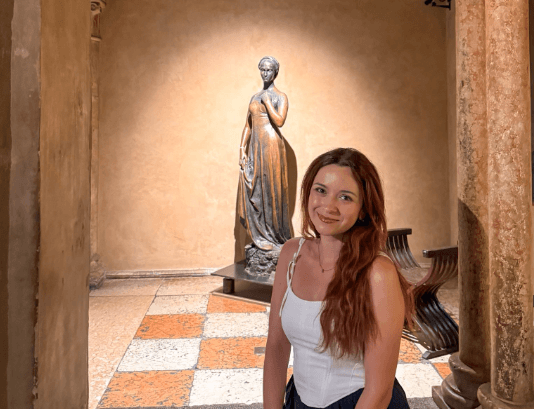
Visiting Juliet’s House in Verona is one of the most striking experiences I’ve ever had in Italy. Before traveling, I knew that Verona was the city immortalized by Shakespeare in the tragedy “Romeo and Juliet,” but I confess I didn’t imagine the almost magnetic force this place holds. Upon arriving, I quickly realized that it is not just a tourist attraction; it is a space filled with symbolism, legends, traditions, and also controversies.
Article Content
- 1 The History of Juliet’s House
- 2 Romeo and Juliet in Verona
- 3 What to See at Juliet’s House
- 4 Letters to Juliet
- 5 The Movie
- 6 The Tradition of Touching Juliet’s Statue’s Breast
- 7 Romeo’s House: The Forgotten Other Half
- 8 Is It Worth Visiting Juliet’s House?
- 9 How to Visit Juliet’s House
- 10 Where to Stay in Verona
The History of Juliet’s House
Although Shakespeare never set foot in Verona, the city embraced his play so deeply that it turned what was once pure fiction into reality. Juliet’s House (Casa di Giulietta) is a medieval building from the 13th century that once belonged to the Cappello family. The surname Capuleto (Juliet’s family in the play), and thus the myth was born: that Gothic palace would be the home of Juliet Capulet.
At the beginning of the 20th century, the city decided to restore the building and transform it into a tribute to the most famous love story in literature. Today, it is a museum that blends historical elements with romantic staging: the famous Juliet’s balcony,love letters, film costumes, and spaces that recreate the Renaissance atmosphere.
Romeo and Juliet in Verona
Shakespeare drew on oral traditions and pre-existing Italian stories, but it was he who gave eternal life to the pair of lovers. Romeo and Juliet represent overwhelming passion, the struggle against social conventions, and, sadly, inevitable tragedy.
Walking through the courtyard of Juliet’s House is like stepping into this collective imagination. It is almost impossible not to recall scenes from the book, the stage, or the films. And even knowing that Juliet never lived there, the experience is still deeply moving
What to See at Juliet’s House
- The courtyard with Juliet’s statue – probably the most photographed spot.
- The famous balcony – in fact, it was added only in the 20th century, but it remains the ultimate symbol of romance.
- The museum interior – includes decorated rooms, Renaissance furniture, and costumes used in film adaptations.
- Letters to Juliet – thousands of visitors leave messages on the walls or in mailboxes; some are even answered by volunteers from the Club di Giulietta.
Letters to Juliet
For me, one of the most beautiful aspects of the visit was seeing how thousands of people, of all ages and from all over the world, write letters addressed to Juliet. These are messages of love, confessions, doubts, and even requests for advice.
“These letters do not go unanswered: many are collected and read by a group of volunteers known as the ‘Juliet Club’ (Club di Giulietta), which has existed since the 1930s. These volunteers reply to the senders one by one.
It is remarkable to think that, centuries after Shakespeare, Juliet continues to be seen as a kind of universal confidante of love.
O Filme Letters to Juliet
The myth of the letters became even more famous with the 2010 film “Letters to Juliet” (Cartas para Julieta)starring Amanda Seyfried and Vanessa Redgrave.
The film follows a young American woman who visits Verona, finds an unanswered letter to Juliet, and decides to search for the person who wrote it many years earlier. The story blends contemporary romance with the magic of tradition and inspired even more tourists to write letters and visit the house.
I must admit that when I saw the wall covered in colorful messages, I immediately thought of scenes from the film. Fiction has given this tradition even greater strength.

The Tradition of Touching Juliet’s Statue’s Breast
And here I come to a part that made me feel uncomfortable. There is a tradition of touching the right breast of Juliet’s statue to attract good luck in love. Thousands of tourists do it every day, almost automatically, as if it were a mandatory ritual.
But do they ever stop to think?
In the play, Juliet is only 13 years old. And this practice, which may seem harmless, perpetuates the idea of the female body as a public talisman, available to be touched. Personally, I found it embarrassing to see lines of people rubbing the statue without reflecting on what they were doing.
Yes, I understand that it is a ‘tourist tradition’ and that for many it is just a joke. But I also believe it’s important to question it: to what extent are we normalizing something uncomfortable—and even disrespectful—toward the figure of Juliet?
During my visit, I chose to observe the statue with respect and keep the symbolism of love to myself, without reproducing empty gestures. Will I die alone because of it? Most likely.
Romeo’s House: The Forgotten Other Half
Few people know, but there is also Romeo’s House (Casa di Romeo) in Verona. It is a fortified medieval building that is said to have belonged to the Montecchi family (the Montagues in the play).
Unlike Juliet’s House, it is not a museum and does not have the same tourist appeal. It belongs to a private family, and only the exterior can be seen. Still, I thought it was important to stop by: after all, there is no Juliet without Romeo.
Is It Worth Visiting Juliet’s House?
In my opinion: yes, it is definitely worth visiting,but with awareness. It is not an authentic historical site; it is more of a staged experience. We should think of it as both a tribute and, at the same time, a collective ritual of romance.
The most authentic thing at Juliet’s House is the letters left by anonymous visitors. There, I realized that, regardless of time and culture, human beings continue to seek a vital force in love.
How to Visit Juliet’s House
The attraction is one of the most popular in Verona, and it can be difficult to get tickets on the spot, as they often sell out—especially during the summer months or on weekends. The best way to avoid lines is to purchase tickets online in advancefor example through GetYourGuidewhere you can also find guided tours combined with other city attractions.
Personal tip:I bought a skip-the-line ticket through GetYourGuide and entered without waiting at all. It’s definitely worth it for the peace of mind.
Plan Your Trip
Book your accommodation through Booking.com. It offers the best deals and allows free cancellation, making it a reliable site that helps avoid unpleasant surprises.
On any trip, it’s important to have travel insurance to prevent unexpected problems. IATI Seguros is a company 100% specialized in travel and offers the best value for money. Blog readers can get a 5% discount using this link.
You can also book tours, museum tickets, airport transfers, and skip-the-line attractions through Get Your Guide. Use the 5% discount code: 5%: ACACHOPA5
Juliet’s House in Verona is more than just a tourist attraction: it is a worldwide symbol of love, myth, and our ability to transform fiction into reality. Visiting it feels like stepping into a living theater, where everyone projects their own romantic dreams.
But it is also a space that invites reflection—on the role of traditions, on respect for female figures, and on how we consume stories.
If you are planning to visit Verona, I recommend including Juliet’s House in your itinerary, purchasing tickets in advance through GetYourGuide to avoid lines, and, if you have time, also stopping by Romeo’s House.
Where to Stay in Verona
Luxury Hotels in Verona
- Due Torri Hotel — One of the most prestigious hotels in the city, located near the Church of Santa Anastasia, featuring classic décor and a rooftop with stunning views.
- NH Collection Palazzo Verona — Contemporary luxury in a historic palace, just a few minutes from the Verona Arena.
- Hotel Gabbia D’Oro — Contemporary luxury in a historic palace, just a few minutes from the Verona Arena.
Hotels in Verona with Good Value for Money
- Hotel Accademia — Excellent location in the historic center, comfortable rooms, and a great breakfast.
- Hotel Indigo Verona – Grand Hotel Des Arts — Elegant design, good services, and located between Porta Nuova station and the city center.
- Hotel Giulietta e Romeo — Right next to the Arena; modern, comfortable, and with competitive prices.
Budget Hotels in Verona
- Hotel Verona — Just a few steps from the Arena, with simple yet modern rooms and good prices.
- Hotel Siena — One of the most popular budget options, close to Porta Nuova, offering excellent value for money and location.
- Porta Palio Verona — A budget-friendly and comfortable hotel, ideal for travelers arriving by train or car.
If you enjoyed the article on visiting Juliet’s House, you might also be interested in the following topics: